

By Linda Welzenbach Fries
Brandon Schmandt, a professor of Earth, Environmental and Planetary Sciences, is the co-author of a recent article in the journal Geology with Wenkai Song, a former University of New Mexico graduate student, that balances Yellowstone's hydrothermal heat budget. By combining high-resolution seismic imaging with thermodynamic modeling, the team showed how the underlying magma reservoir fuels the park's famous thermal features, pumping out at least 7.5 gigawatts of power.
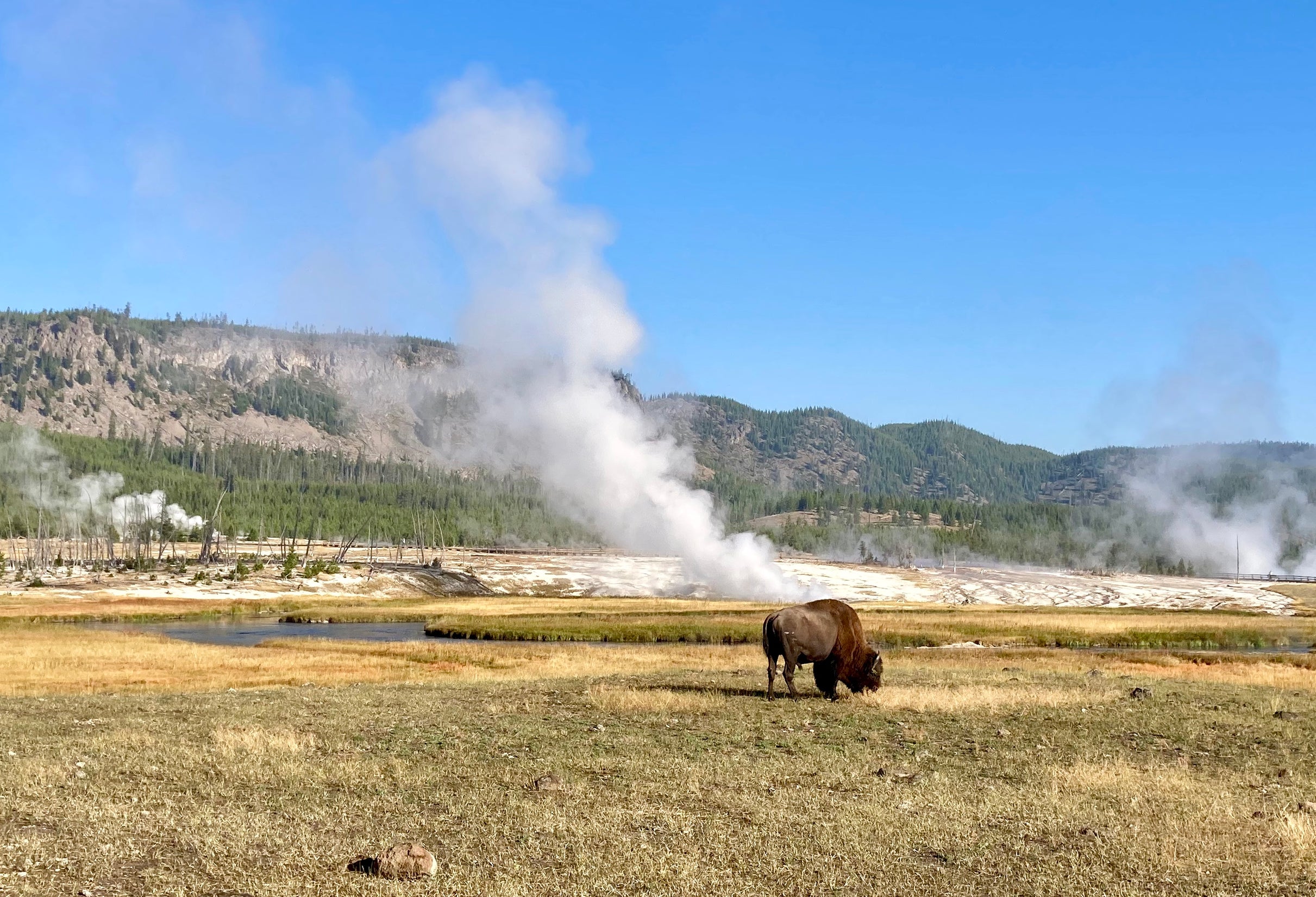
Yellowstone National Park is famous for its dramatic geysers, boiling mud pots and steaming hot springs, which are produced by one of the world's most powerful active volcanic systems. But underneath this geologic wonderland lies a scientific accounting problem: balancing the volume of energy passing from the deep magmatic underbelly with the amount measured at the surface. Geochemists have estimated the volume of heat escaping from the surface water, but matching those numbers to the physical size, depth and temperature of the deep magma reservoir below has been a persistent challenge.
Bison, Fires and Vibe Trucks: Yellowstone’s Seismic Anatomy
The study pairs high-resolution, controlled-source seismic imaging with a thermodynamic model of how heating water infiltrates the hot subsurface at Yellowstone. Gathering the underlying seismic data required navigating the chaotic realities of a wild national park.
To map the roof of the magma reservoir, the team deployed two controlled-source seismic transects across the 0.63 million-year-old caldera — one in the northeast and one in the southwest. The controlled source was a heavy, truck-mounted vibrator that sent signals into the ground at 128 locations, which were captured by 447 highly sensitive seismometers. This array allowed them to catch sharp, high-frequency reflections bouncing directly off the roof of the magma reservoir.
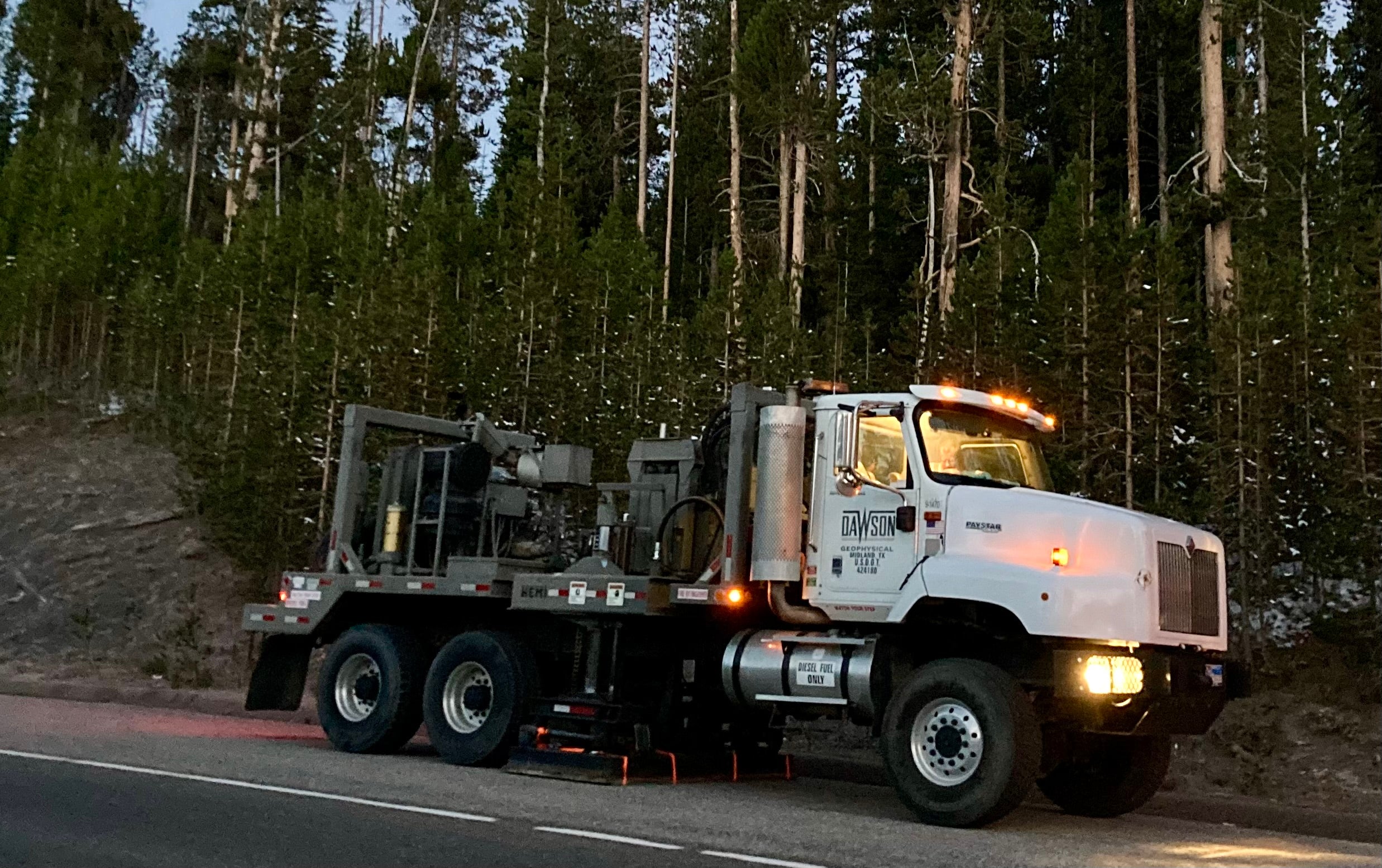
However, the two transects yielded different data quality. The northeast transect was highly successful, but the southwest one was "not nearly as pretty," according to Schmandt. The discrepancy came down to unexpected variables: Yellowstone’s wildlife and wilderness hazards.
Schmandt explained that their vibration points were skewed because the team could only park at paved roadside turnouts. "There are more buffalo in northeast Yellowstone, so there are more paved roadside turnouts to prevent traffic jams, and there are fewer buffalo in the southwest, resulting in fewer available vibe points," he said.
Compounding the lack of roadside turnouts in the southwest, nature threw even greater obstacles at the crew. With a forest fire actively burning toward their seismic array and ongoing bridge construction blocking the roads, local conditions effectively screamed, "Don't drive your vibe truck here".
While they could not perform the same continuous 2D imaging in the southwest, doctoral student Wenkai Song successfully captured distinct P-wave and S-wave reflections. The data confirmed that the same magmatic reflector was present across a massive portion of the caldera, sitting just a few hundred meters deeper in the southwest.
Catching Waves
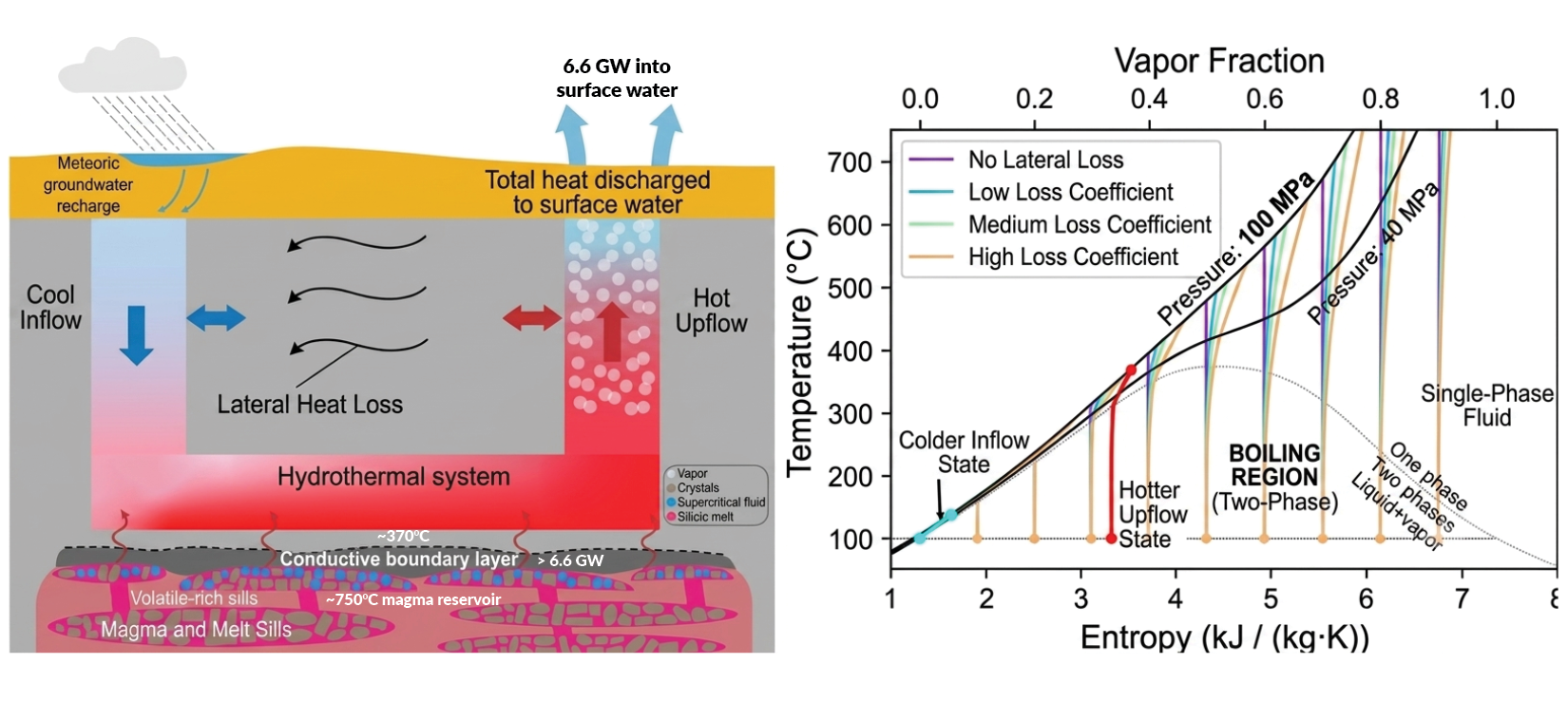
The controlled vibrations sent into the earth returned high-frequency, 15-hertz and 20-hertz reflections bouncing directly off the top of the magma reservoir. Because these reflections have short seismic wavelengths, the data indicated that the physical transition at the roof of the reservoir had to be sharp. Mechanically, this meant the conductive boundary layer — the solid rock ceiling separating the molten magma from circulating groundwater — is likely 120 meters or less.
Once they had the physical dimensions of the magma chamber roof and the ceiling's thickness, they plugged them into a thermodynamic engine cycle model — a mathematical framework used to simulate and analyze how heat is converted into mechanical work inside an engine, in this case the Yellowstone supervolcano.
Geochemical data shows that very little of the water erupting from Old Faithful or boiling in the hot springs is juvenile magmatic fluid. Well over 99% of that volume comes from snow or rain. Snowmelt and a smaller amount of rain at Yellowstone drains into the ground, supplying the hydrothermal engine with water at an average rate of approximately 4,000 liters per second. The water may seep down as far as about 4 kilometers until it approaches the hot rock layer directly above the magma chamber.
Schmandt characterized the park as "basically a big bowl of snow that keeps infiltrating, heating that water and bringing it back up".
Beyond the Geysers: Why This Outcome Matters
Understanding that the magmatic heat supply can meet or exceed the estimated surface output is a reassuring confirmation of previous geochemical work, but the structural details revealed by this balance sheet provide the true scientific excitement.
Evidence of Active Magma Recharge
A boundary layer thinner than 120 meters should not stay that thin on its own. Without a fresh supply of heat, the magma roof would cool, crystallize and thicken downward over time. The fact that it remains thin implies that Yellowstone's magma reservoir is experiencing active, ongoing magma recharge over timescales of at least centuries. Fresh, deep magma is reloading the system, keeping the stove hot enough to prevent the crust from building a thick, gradual transition layer that would not transfer heat as efficiently. This gives volcanologists invaluable insights into the supervolcano’s modern state of repose and its long-term volcanic life cycle.
A Natural Analog for Superhot Geothermal Production
As the world transitions to green energy, geothermal science is pushing to drill into deeper and hotter environments, specifically targeting supercritical water temperature zones near magma chambers. Water becomes supercritical at high temperatures and pressures, holding significantly more energy than standard steam.
The study proves that system-scale thermal budgets of volcanic fields can be accurately mapped on continents. Yellowstone has one of the largest shallow upper crustal magma reservoirs in the world, so it likely provides an example near the high end of steady-state geothermal energy flux. Industrial systems are increasingly trying to engineer their own smaller-scale hydrothermal reservoirs, called enhanced geothermal systems, in similarly hot rock by controlling fracture pathways and fluid flow.
Keeping the Stove On
Today, Yellowstone's upper crustal reservoir stores magma at the same depth interval that fueled most of its ancient, cataclysmic super-eruptions — but measures roughly 40% of its prehistoric area and holds much less melt. By validating that high-frequency seismic arrays can pinpoint the margins of a magma reservoir's extent, Schmandt and his collaborators have provided a vital new toolkit. Whether deployed to safely tap into Earth's deepest heat or to monitor the resting state of similar volcanic systems, balancing the thermal budget brings humanity one step closer to understanding the heat engine of our planet.
References:
Wenkai Song, Brandon Schmandt, Frederic Y.K. Lam, Chenglong Duan, Jamie Farrell, Fan-Chi Lin, Ross Maguire, Lindsay L. Worthington, Leif Karlstrom; Balancing Yellowstone's hydrothermal heat budget with a seismically constrained magma reservoir. Geology 2026;; 54 (6): 588–592. doi: https://doi.org/10.1130/G54324.1