
By Linda Welzenbach Fries
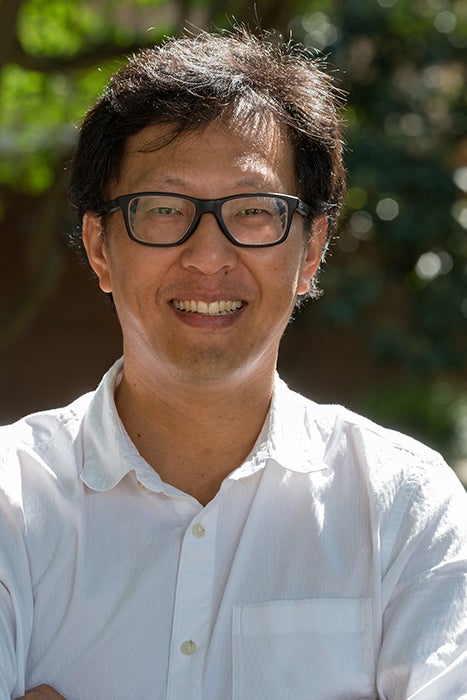
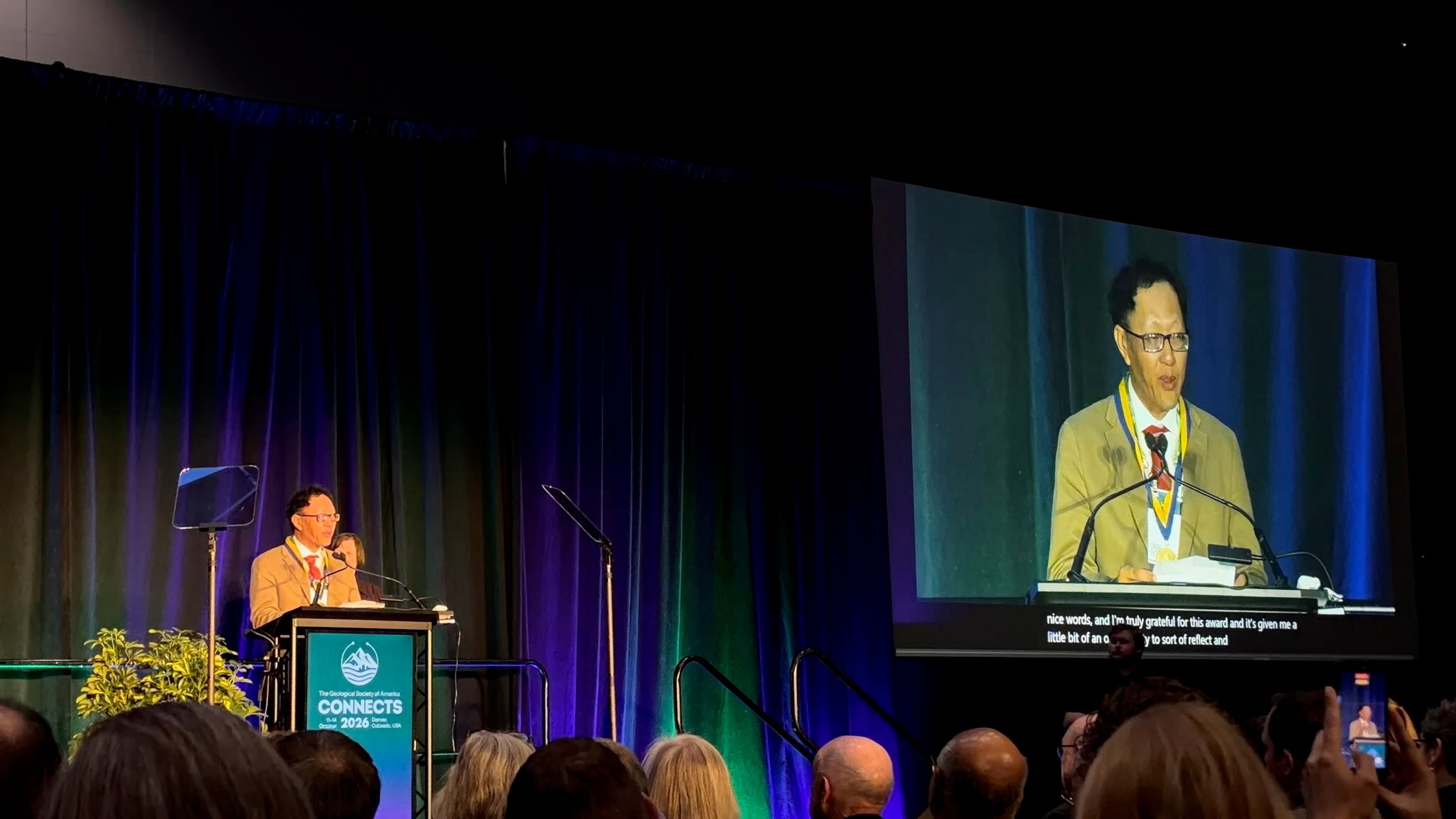
Earth, Environmental and Planetary Sciences (EEPS) Professor Cin-Ty Lee was officially awarded the prestigious Arthur L. Day Medal. The ceremony took place on Sunday, October 11, 2026, during the Geological Society of America (GSA) Connects 2026 annual conference in Denver, Colorado. The award recognizes Cin-Ty Lee for his outstanding contributions to field geology, petrology, and geochemistry.
The Arthur L. Day Medal of the Geological Society of America was established by Arthur Louis Day in 1948. Day was an American geophysicist, physical chemist, and volcanologist who pioneered the application of exact physical science and quantitative chemistry to geological systems.
Day earned his Ph.D. from Yale in 1894, went on to conduct fundamental thermometry research in Germany and then at the U.S. Geological Survey until 1906. From 1907 to 1936, Day served as the founding Director of the Carnegie Institution of Washington’s Geophysical Laboratory. His pioneering accomplishments include developing precise high-temperature gas thermometry scales, mapping phase diagrams for silicate minerals like the feldspar group and conducting landmark field studies on active volcanoes.
Day established the medal to recognize scientists who continue his career mission: advancing geologic knowledge through basic physical and chemical methods. Open to researchers internationally regardless of citizenship or GSA membership, the award evaluates nominees strictly on original research achievements.
Lee’s body of work exemplifies the quantitative, interdisciplinary approach envisioned by Day. His research spans magmatic processes in island and continental arcs, ore-mineral geochemical cycles, chemical weathering, and the long-term evolution of Earth’s atmosphere.
With more than 200 publications cited over 20,000 times, Lee's scholarship has significantly advanced modern understanding of deep crustal processes, planetary differentiation, ore deposit formation, magmatic processes, and long-term climate.
During the award presentation, Lee reflected on the importance of the human element that shapes scientific discovery. "I'm truly grateful for this award, and it's given me time to sort of reflect," Lee said. "We think of science as truly objective, but it's not. The path one takes, the hypotheses one tests or formulates, we are ultimately influenced by what we see, especially as geologists, and also those who we interact with."
Lee also highlighted how his early geological background and mentorship by scientists like Doug Morton, George Brimhall, and his Ph.D. advisor Roberta Rudnick has framed his approach. "I fell in love with the lithospheric mantle and the lower crust in the Sierra Nevada," Lee noted. “It is this lower crustal research that influenced my thinking on deep crustal differentiation controls on magma redox or even copper porphyries."
In keeping with the spirit of scientific inquiry, Lee emphasized the importance of remaining open to evolving models, particularly regarding how deep mantle processes link with the shallow crust. "Maybe all of this is linked,” Lee reflected. "All I know is that I must make sure that I don't trick myself into thinking that I ever really understand. I still have much more to learn and see."