
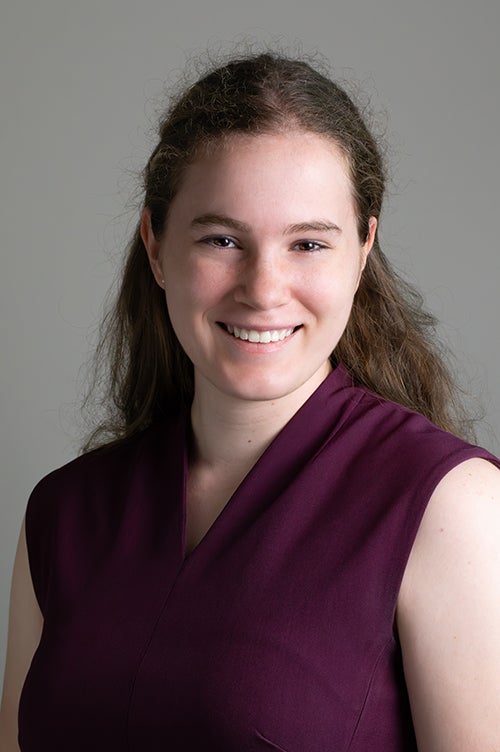
In this edition of our EEPS Student Spotlight series, undergraduate program coordinator Ari Johnson and science writer Linda Fries sit down with recent Rice University graduate Nyla Hartigan ('26). Nyla recently received the prestigious National Science Foundation Graduate Research Fellowship Program (NSF GRFP) in Geosciences - Climate and Large-Scale Atmospheric Dynamics. In this candid interview, Nyla reflects on earning a dual degree, balancing club sports and music with rigorous science coursework, navigating multiple research projects at Rice, and preparing for her upcoming Ph.D. studies at Princeton University.
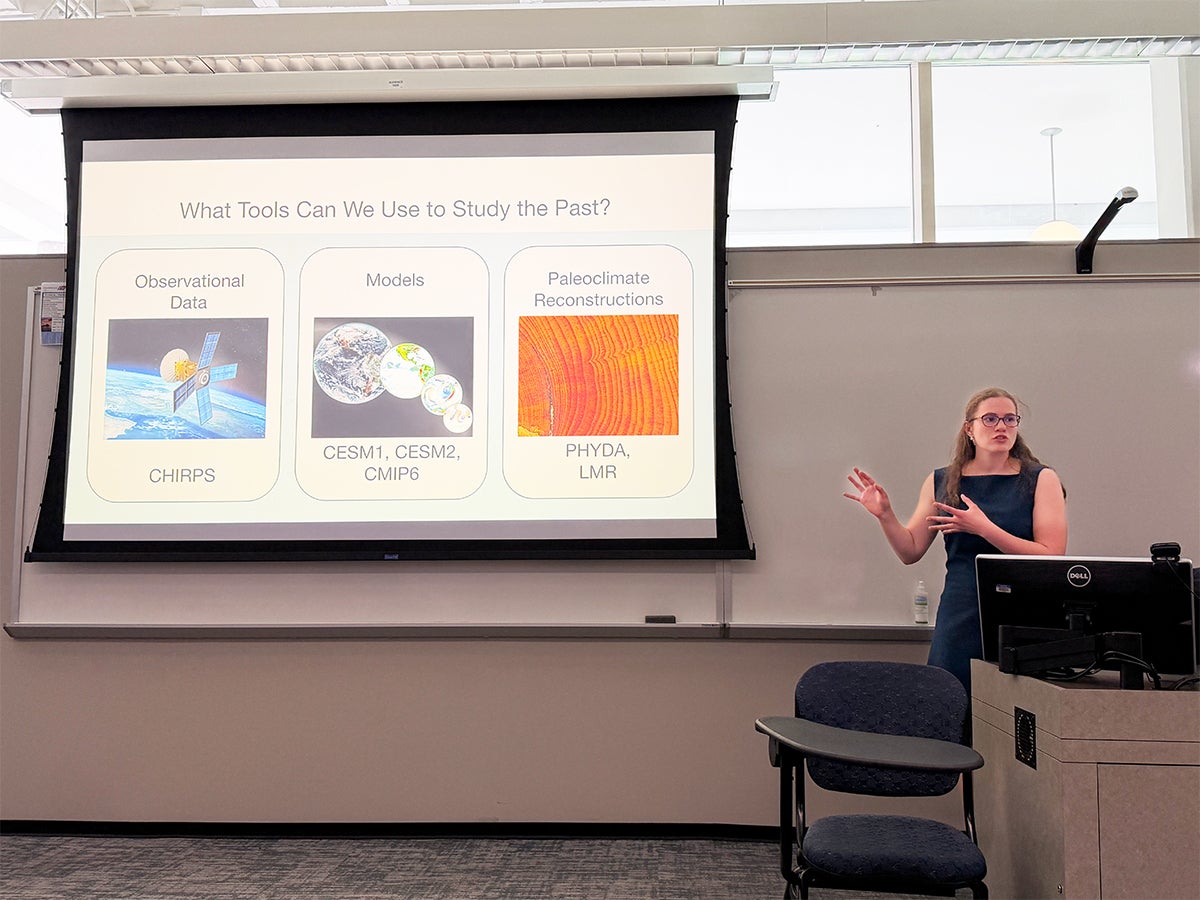
Academics & Crafting a Dual Degree
Ari Johnson: Can you share your residential college, graduation date, and the degrees you received at Rice?
Nyla Hartigan: I’m from Jones College, and I graduated in May 2026. I earned a Bachelor of Science in Earth, Environmental and Planetary Sciences (EEPS) and a Bachelor of Arts in Physics.
Linda Fries: Why did you pick physics as a dual degree alongside EEPS?
Nyla Hartigan: Honestly, I just really enjoyed taking physics classes! I thought the subject matter was cool, and coming into Rice, I wasn't entirely sure what direction I wanted to take. So, I took classes that interested me. When I looked at the physics major requirements later on, I realized I could get the B.A. by taking just a few additional courses.
At Rice, a dual degree gives you two separate physical diplomas rather than a double-major notation, but it requires at least 150 credit hours. Because I played in the Rice Orchestra all four years—which added a credit hour every semester—and had a few AP credits, I ended up at 151 hours, just crossing the threshold to get the dual degree in four years.
Linda Fries: Did your physics background help in your earth science coursework and research?
Nyla Hartigan: Definitely. In my view, Earth science is applied physics. Having that foundational background was extremely helpful during my research. Physics classes teach you how to think critically. You're given complex problems and resources, and you have to use critical thinking to solve them. Research works the exact same way when you take existing literature and try to build something new.
Extracurriculars, Music & Championship Lacrosse
Ari Johnson: When you weren't studying or conducting research, what extracurriculars were you involved in, and how did you balance everything?
Nyla Hartigan: It came down to balancing different interests and keeping up with hobbies I loved. I played lacrosse in high school, and when a few students started the Rice Women’s Club Lacrosse team during my sophomore year, I joined right away. We practiced twice a week, went on fun road trips, and actually won our division this year as Texas Women's Lacrosse League Division II Champions!
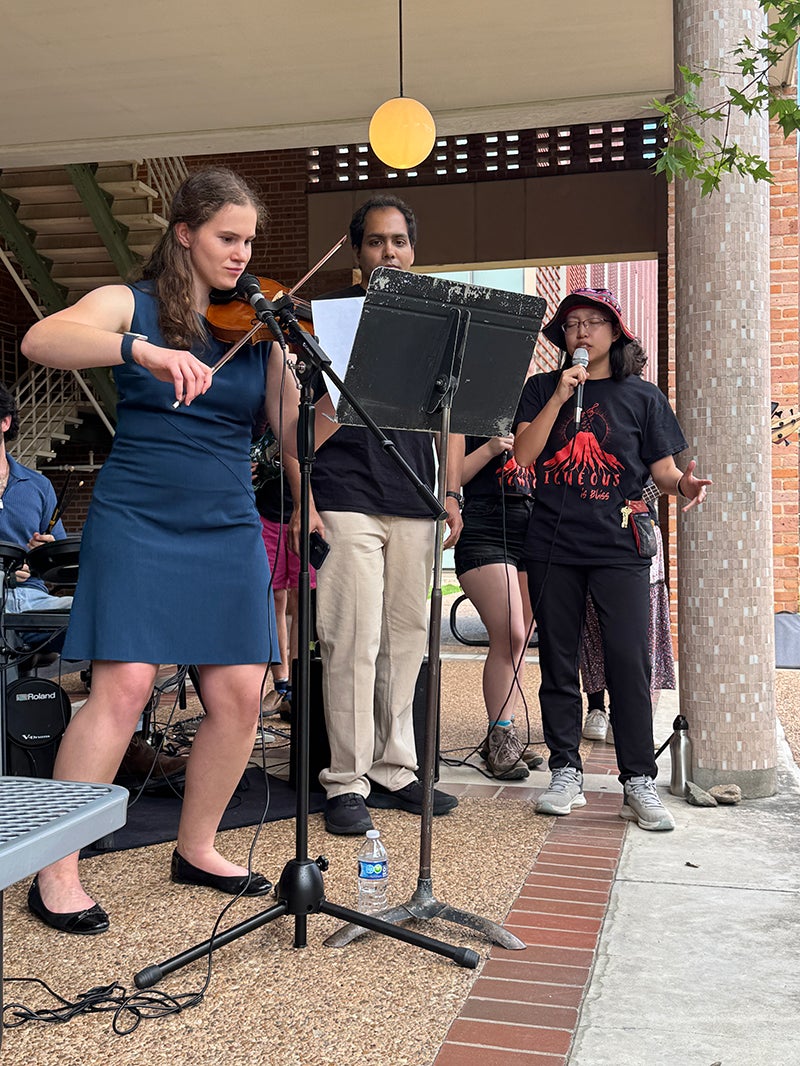
For music, I played in the Rice Orchestra, which rehearsed every Saturday from 10 a.m. to 1 p.m. I also played in the EEPS departmental band, Igneous's Bliss, served as Treasurer for RUGS (Rice Undergraduate Geology Society), and worked as a Peer Academic Advisor (PAA) and Head Fellow. For work, I was a front desk assistant in the Career Development Office at the Jones Graduate School of Business.
Linda Fries: That requires a lot of organization! How did you manage all those commitments?
Nyla Hartigan: My Google Calendar was the only reason I stayed on top of everything! If it wasn't on my Google Calendar, it was really hard to track. It was a give-and-take—during finals or thesis writing, research and classes took priority, and I’d communicate with my advisor or lacrosse captains if I needed to miss a practice. Having supportive people across Rice made it all work.
Undergraduate Research Journey at Rice
Ari Johnson: Could you describe the research projects you conducted during your time at Rice?
Nyla Hartigan: I worked on three distinct projects, which really helped me discover what I enjoyed:
- Mars Ancient Lake Modeling: As a freshman, I cold-emailed Dr. Kirsten Siebach and Dr. Sylvia Dee the summer before matriculating. Working under Ellie Moreland, I helped make visualizations and design model runs for understanding an ancient lake on Mars, which was a great introduction to scientific coding and figures.
- Subsurface Thermal Gradients: Through the Rice Explore program, I spent a semester working with Dr. Jonathan Ajo-Franklin measuring subsurface thermal gradients underneath Rice using optics and laser equipment for geothermal energy applications.
- Senior Honors Thesis in Paleoclimate: Working with Dr. Dee over my last year and a half, I analyzed long-term hydroclimate variability in the Middle East. Motivated by recent flooding events in the Arabian Peninsula, my project investigated whether modern climate extremes differ from natural historical variability.
Winning the NSF Graduate Research Fellowship
Linda Fries: How did you approach applying for the NSF GRFP, and what was your proposal about?
Nyla Hartigan: I learned about fellowship opportunities through my parents, who work in academia, and advising programs. During the summer before senior year, I prepared several applications, including the Gates Cambridge, Marshall, and GRFP.
For my GRFP essay, instead of writing an extension of my senior thesis, I proposed a new idea: aggregating data from personal backyard weather stations across Gulf Coast cities to construct a high-resolution dataset for analyzing urban rainfall patterns.
Ari Johnson: What made your application strong, and how did you find out you received the award?
Nyla Hartigan: The GRFP evaluates Broader Impacts and Intellectual Merit. For broader impacts, my proposal focused on citizen science and community weather monitoring. For intellectual merit, I demonstrated that my idea was supported by the literature and that my Rice research experience gave me the statistical and large-data analysis skills required. Dr. Sylvia Dee provided incredible guidance and recommendation letters, and Rice's Office of Undergraduate Research and Inquiry (OURI) helped polish my application essay structure.
I actually found out I won while sitting in Saturday orchestra rehearsal! A friend texted me congratulations because the official award list had been published online. I was in disbelief at first, but incredibly excited!
Linda Fries: Since the NSF GRFP funds the individual researcher rather than a specific project or institution, where are you headed next?
Nyla Hartigan: That's the great thing about the GRFP—the funding follows you! I accepted the offer to pursue my Ph.D. at Princeton University in Civil and Environmental Engineering, starting this August.
Post-Graduation Travels
Linda Fries: What have you been doing since graduation in May?
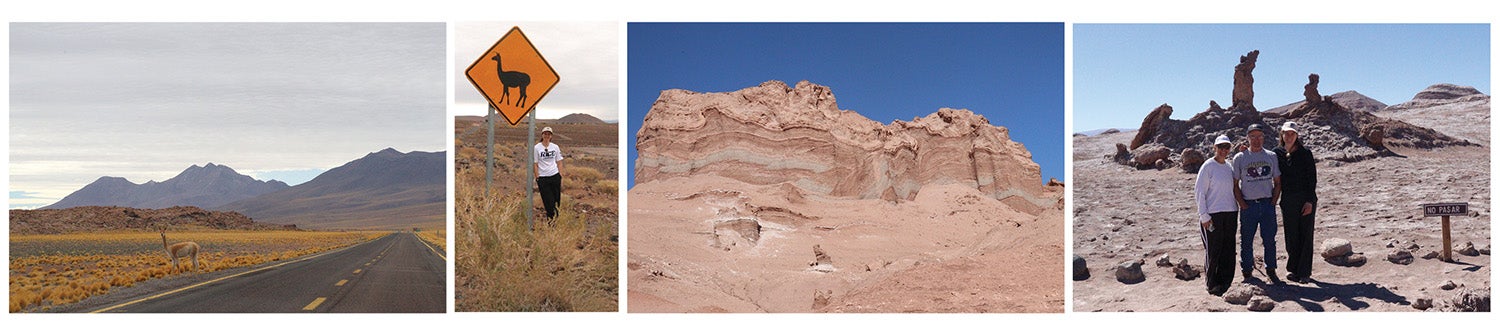
Nyla Hartigan: Lots of travel and relaxation! My family took a post-graduation trip to the Atacama Desert in Chile. Both of my parents love astronomy, and the Atacama sky was the darkest I've ever seen—you could see the entire Milky Way. We saw llamas, drove through mountain passes, and visited Valle de la Luna. Having just taken the EEPS field trip class, I was pointing out geological structures to my parents like, "Look, that's a syncline!" and spotting gypsum veins.
After Chile, I went to Kauai, Hawaii with friends for hiking and surfing, and now I've been packing up before moving east for graduate school.
Advice for Future Undergraduates
Ari Johnson: What advice would you give to current and prospective Rice undergraduates?
Nyla Hartigan:
- Get Involved in Research Early: Cold-email professors whose work interests you or sign up for structured programs like the Explore program. Trying different labs helps you figure out what you genuinely enjoy.
- Build Relationships Naturally: Don't be afraid of the word "networking". Simply engage in classes, ask questions, speak with faculty, book Zoom chats with potential advisors, and present posters at conferences like AGU.
- Take Advantage of Rice Resources: OURI and the Undergrad Scholars Program provide essay feedback and financial support—including a $1,000 stipend that helped cover my graduate school application fees across 16 programs.
- Just Apply: Put yourself out there! You might face rejections along the way, but you only need one "yes.”
Summary of Nyla's Key Accomplishments
- Degrees: B.S. in EEPS & B.A. in Physics (Jones College '26, 151 Credit Hours)
- Honors: NSF Graduate Research Fellowship Program (GRFP) in Geosciences - Climate and Large-Scale Atmospheric Dynamics
- Next Destination: Ph.D. Student in Civil & Environmental Engineering at Princeton University
- Activities: Texas Division II Champion (Rice Women's Club Lacrosse), Rice Orchestra, Igneous's Bliss Band, Peer Academic Advisor, RUGS Treasurer, Front Desk Assistant at the Jones School