
By Linda Welzenbach Fries
Marble is about as simple as a rock gets. Mineralogically it is mostly calcite and dolomite, with only trace amounts of anything else. But a new study in Mineralogy and Petrology shows that simplicity is deceptive.

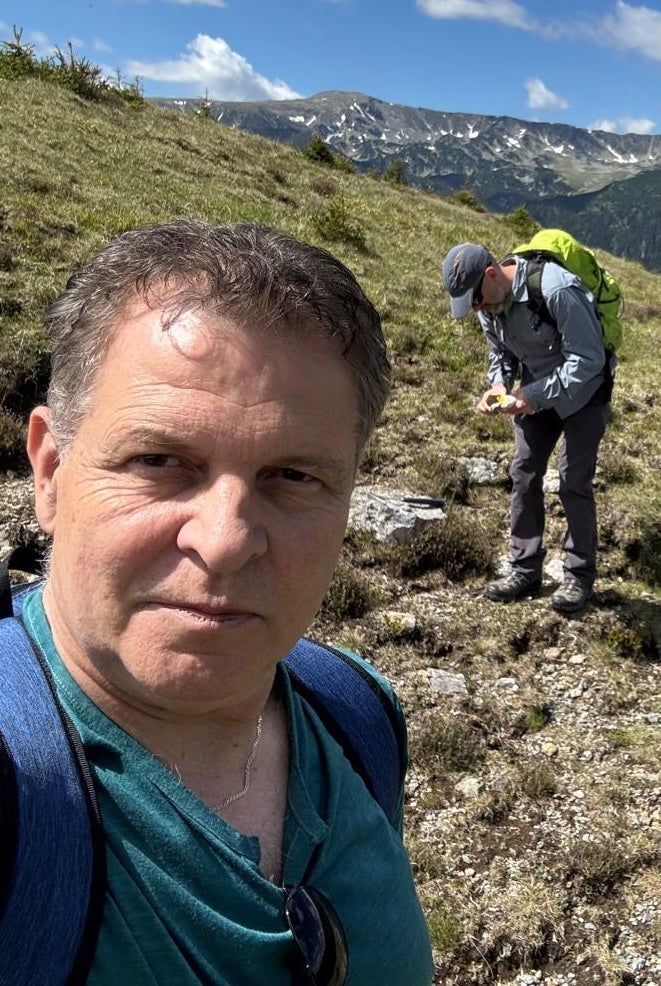
Working high in the Făgăraș Mountains of the Southern Carpathians in Romania, Gelu Costin, a research scientist in Rice’s Department of Earth, Environmental and Planetary Sciences, and colleagues Maria-Laura Tîrlă, Relu-Dumitru Roban and Ionuț-Cornel Mirea from the University of Bucharest and the ”Emil Racoviță” Institute of Speleology, Romanian Academy, found that these ordinary stones store a detailed record of Earth’s history spanning hundreds of millions of years. Their paper is the first to lay out a quantitative pressure-temperature history for marbles of this kind.
“Marbles look deceptively simple in mineralogy and textures, yet these rocks turn out to be remarkably detailed archives, preserving signals from every stage of a long and complicated history,” says Costin, the paper’s lead author.
The story preserved in the Făgăraș marbles begins long before Europe took its modern shape. The original carbonate sediments piled up on a shallow continental shelf along the northern edge of the ancient supercontinent of Gondwana. Sand-sized grains of other minerals — plagioclase, rutile, titanite, zircon and apatite — washed into that carbonate-rich basin from nearby landmasses and were buried along with them.
“These relict detrital grains point back to the original sediment. Today’s dolomite records everything that has happened since,” Costin says.
From Mountain Peaks to Electron Beams
The project began with marble samples collected from caves during a geographical survey of the Făgăraș Mountains. Co-author Laura Tîrlă asked Costin to look at what her samples were made of.
“If you had asked me 20 years ago to write a paper on marbles, I would have said that simple calcite and dolomite, with perhaps a little other mineralogy, is not enough to do this kind of thermobarometric study,” Costin says.
Reconstructing the history of the Făgăraș marbles meant bridging two very different scales of observation: the regional tectonic setting, measured in miles, and the microscopic realm, measured in microns, where chemical reactions between individual mineral grains can be seen directly.
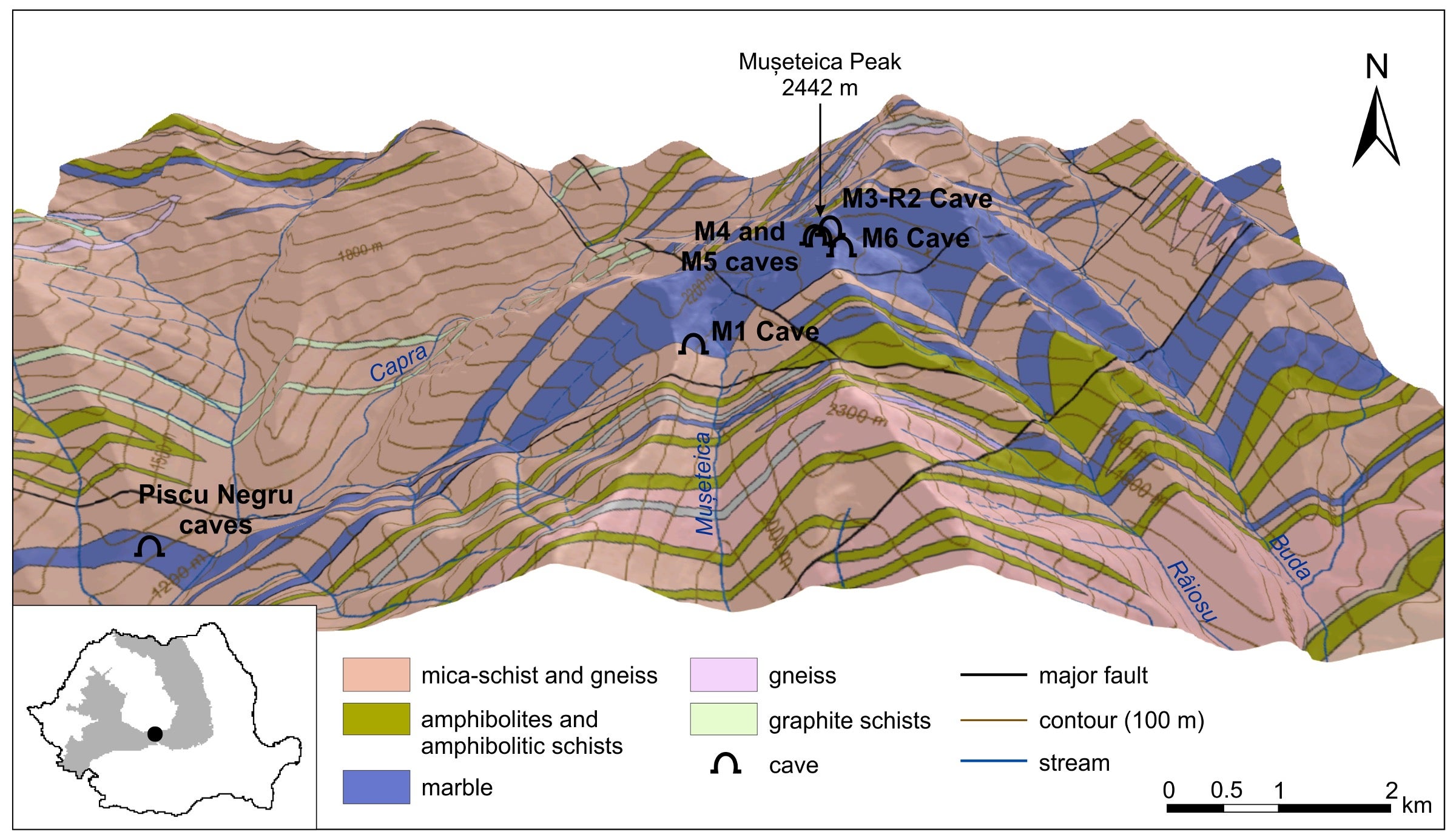
In the field, structural context was critical. The team documented the relationships between light-gray foliated marbles, isolated lenses, cross-cutting vein networks and major tectonic shear zones. Pure dolomitic marbles dominated the high ridge crests while calcitic marbles were exposed mainly as thin bands near structural contacts. To capture those regional patterns, the team sampled as much marble diversity as they could find.
Under the microscope, the samples showed fine-grained granoblastic textures — interlocking marble crystals of roughly equal size with no preferred alignment — along with a range of other microstructural and mineralogical clues.
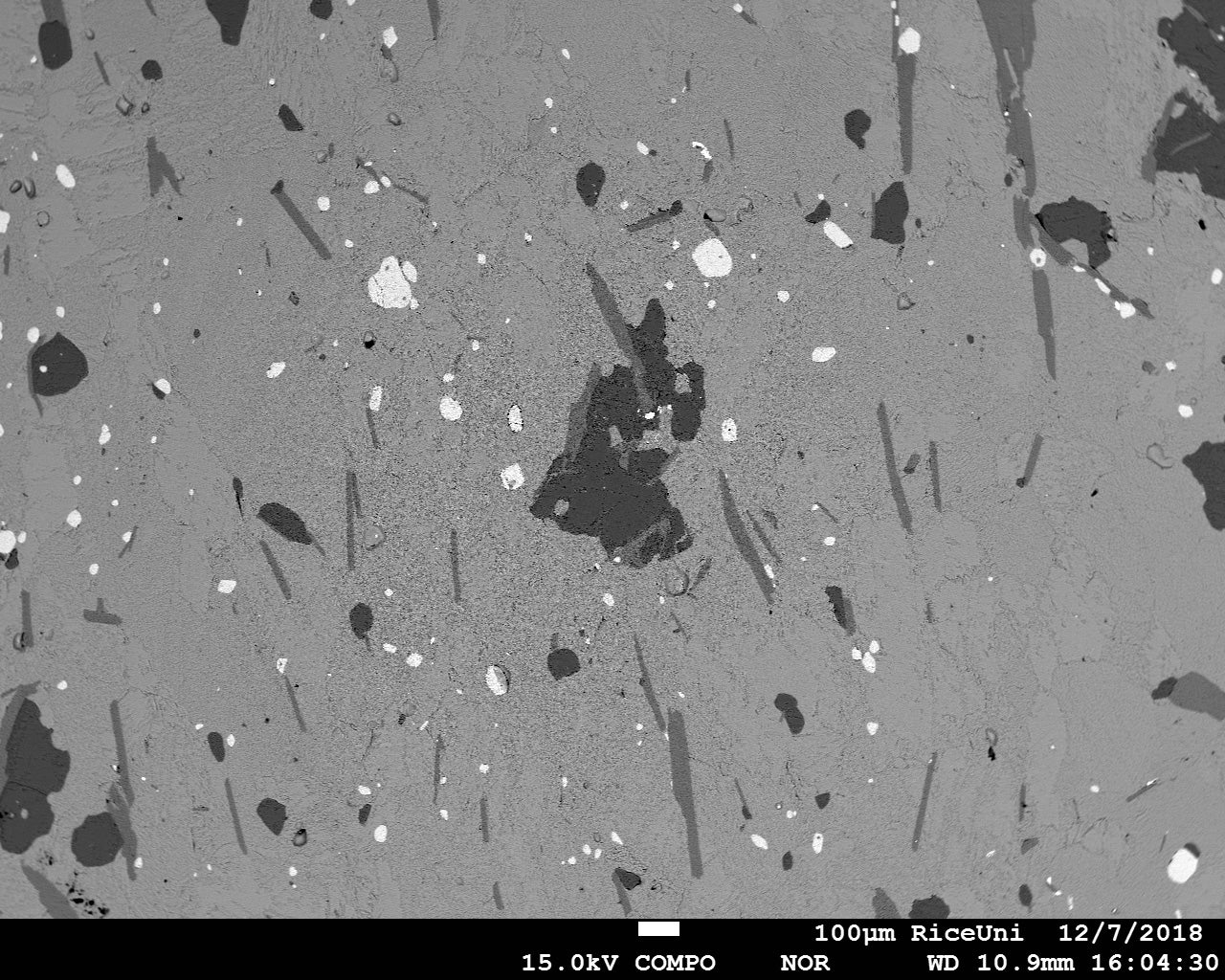
Electron probe microanalysis (EPMA) carried out by Costin at Rice revealed chemical changes as well, from alteration along carbonate grain boundaries such as iron-depleted dolomite margins to original mineral inclusions: relict quartz, fluorapatite and fluorine-rich micas aligned along the foliation planes.
Combining those observations with the EMPA data, calcite-dolomite solvus thermometry — a laboratory technique that measures magnesium exchange between carbonate minerals to calculate ancient temperatures and pressures — the team reconstructed four distinct chapters of the region’s past:
- Ancient oceans: Original carbonate-rich sediments accumulated on a shallow platform off Gondwana, picking up tiny mineral grains washed in from surrounding land. Later, dolomite formed.
- Deep-earth heating and pressure: During the mountain-building event, tectonic forces buried the sedimentary rocks up to 18 km deep, heating them to between 572 and 617 degrees Celsius (1,062 to 1,143 degrees Fahrenheit).
- Cooling, uplift, and compression: As the rocks were uplifted and cooled to around 435 degrees Celsius (815 F), new minerals such as micas formed. Later, during the Alpine mountain-building phase, rocks were stacked into a complex system of low-angle thrust sheets, or nappes.
- Late-stage hydrothermal fluids: Much later, warm fluids between 105 and 195 degrees Celsius (221 to 383 F) moved through fractures between the nappes, depositing iron, copper, lead and zinc minerals in the rock.
This multi-stage history doesn't just reveal the story of a single mountain range — it changes how geologists can study all ancient marbles.
Costin’s work also provides a methodological takeaway for future researchers: Whole-rock geochemical studies of marbles can be misleading if performed without an initial look at the rock at the smallest of scales. Because fluid percolation, detrital grain contamination and mineral replacements can blur chemical signals, scientists must first decipher the micro-scale history of marble.
"The study of these marbles, and of metamorphic carbonates more broadly, helps us understand how carbonate rocks respond to changing metamorphic and hydrothermal conditions," notes co-author Laura Tîrlă. "Through the elements they gain or lose, and through their interactions with other minerals and fluids, we have shown that carbonates can preserve a record of the geological processes that shaped the rocks — and, in favorable cases, offer clues to the evolution of the entire host unit."
By demonstrating how field-based structural mapping and laboratory-based micro-thermobarometry reinforce one another, Costin and his colleagues offer a clear template for geoscientists studying complex, multi-stage mountain belts around the globe.
References:
Costin, G., Tîrlă, M.L., Roban, R.D. et al. Mineralogy and thermobarometry of marbles: constraints on retrogression and hydrothermal imprint in a polymetamorphic terrane (Făgăraș Unit, Southern Carpathians, Romania). Miner Petrol (2026). https://doi.org/10.1007/s00710-026-00995-9